Current Sensing Copper Alloys: How Material Choice Affects TCR, Resistance and Stability
Current sensing copper alloys are not interchangeable materials with different names. In a low-ohmic current sense resistor, the alloy influences how much resistive material is required, how resistance changes with temperature, how strongly thermoelectric voltage can affect a millivolt-level signal, and how stable the calibrated resistance remains after repeated electrical and thermal stress.
That distinction becomes increasingly important as resistance moves from tens of milliohms toward the sub-milliohm range. At that point, the electrical behavior seen by the measurement circuit is no longer determined by alloy resistivity alone. The resistive element, copper terminals, joining method, geometry, thermal gradient and specified temperature range all contribute to the final component performance.
The material name tells you what the resistive element is made from. It does not, by itself, tell you the TCR, thermal EMF or stability of the finished current sense resistor.
Why Alloy Choice Changes More Than the Nominal Resistance
The nominal resistance printed on a datasheet is only one point in the current-sensing error budget. Two resistors can both be specified as 1 mΩ and still behave differently as current, temperature and operating time change.
For material selection, four properties deserve particular attention: electrical resistivity, temperature coefficient of resistance, thermoelectric behavior and long-term resistance stability.
| Material Property | What It Changes in the Resistor | Why It Matters to Current Measurement |
|---|---|---|
| Electrical Resistivity | Required element length, width and thickness for a target resistance | Affects geometry, current density, power density and package design |
| TCR | Resistance change as element temperature changes | Creates gain error in the current-to-voltage conversion |
| Thermal EMF | Additional thermoelectric voltage at dissimilar-material junctions | Can introduce offset when the shunt signal is only millivolts or microvolts |
| Long-Term Stability | Permanent resistance shift after thermal and electrical stress | Affects calibration accuracy over the service life of the system |
These properties are related, but they are not the same. A material with attractive resistivity does not automatically provide the lowest TCR. A low-TCR alloy does not guarantee low thermal EMF against every terminal material. And excellent initial TCR does not guarantee negligible long-term drift after thousands of thermal cycles.
Resistivity Determines the Physical Starting Point
Electrical resistivity determines how much material is required to produce a given resistance. This has a direct effect on the physical design of a current sense resistor.
For a uniform resistive element:
R = ρL / A
where ρ is the material resistivity, L is the effective current-path length and A is its cross-sectional area.
This relationship explains why material selection cannot be separated from geometry. If a higher-resistivity alloy is used, a designer may be able to achieve the target resistance with a shorter or thicker current path. If the resistivity is lower, the geometry must compensate.
That geometry then affects current density, thermal spreading, inductance and the amount of terminal material that contributes to the measured resistance.
Low Resistance Is Not Achieved by Material Choice Alone
When the target value reaches 1 mΩ, 0.5 mΩ or below, simply choosing a suitable copper-based resistance alloy is not enough. The element geometry must be controlled closely because a small dimensional change represents a meaningful percentage of the total resistance.
This is one reason the same alloy family can appear with different resistance ranges and TCR specifications across different resistor constructions. The finished device is the result of both material properties and geometry.
TCR Converts Temperature Change into Measurement Error
The temperature coefficient of resistance describes how resistance changes as temperature changes. For current sensing, that resistance change becomes a measurement gain error because current is calculated from the voltage developed across the shunt.
A simplified relationship is:
ΔR / R0 ≈ α × ΔT
where α is the TCR and ΔT is the temperature change from the reference condition.
If the actual resistance increases while the controller continues to calculate current using the original resistance value, the reported current will shift accordingly.
Self-Heating Makes TCR a Load-Dependent Error
TCR is sometimes discussed only in terms of ambient temperature, but current sense resistors also heat themselves.
As load current increases, I²R dissipation raises the element temperature. The resistor may therefore experience a substantial internal temperature rise even when the surrounding air temperature remains constant.
This means TCR can turn load current into a secondary measurement error:
Current rises → shunt dissipates more power → element temperature rises → resistance changes → measured current ratio shifts.
For that reason, low TCR is especially valuable where the resistor operates across a wide current range or spends significant time near its thermal limit.
Element TCR and Component TCR Are Not the Same Specification
One of the most important distinctions in low-resistance sensing is the difference between the TCR of the resistance alloy and the TCR of the complete resistor.
A metal current sense resistor usually contains more than the precision alloy. Copper terminals, electrodes, plated interfaces or welded conductor sections are required to carry current into and out of the resistive element.
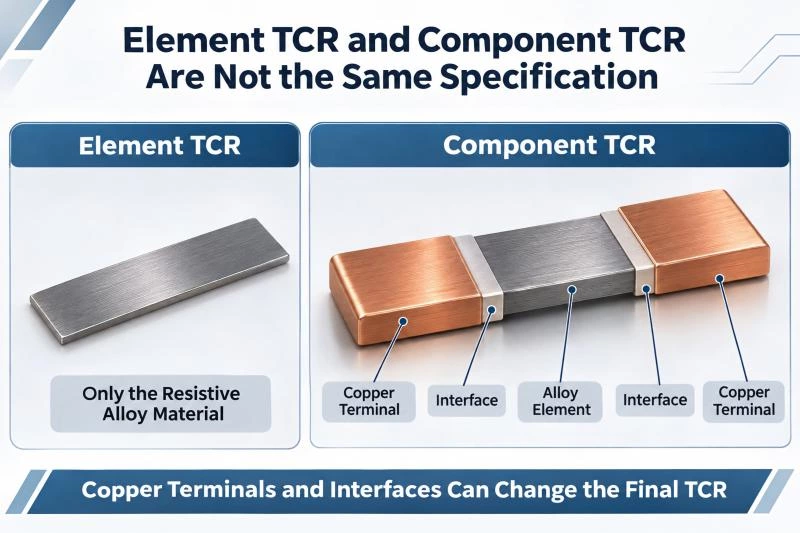
Copper is attractive because of its very low electrical resistance and high thermal conductivity. However, its temperature coefficient is much higher than that of a purpose-designed resistance alloy.
As a result, the total measured resistance can be represented conceptually as:
Rcomponent = Ralloy + Rterminal contribution + Rinterface contribution
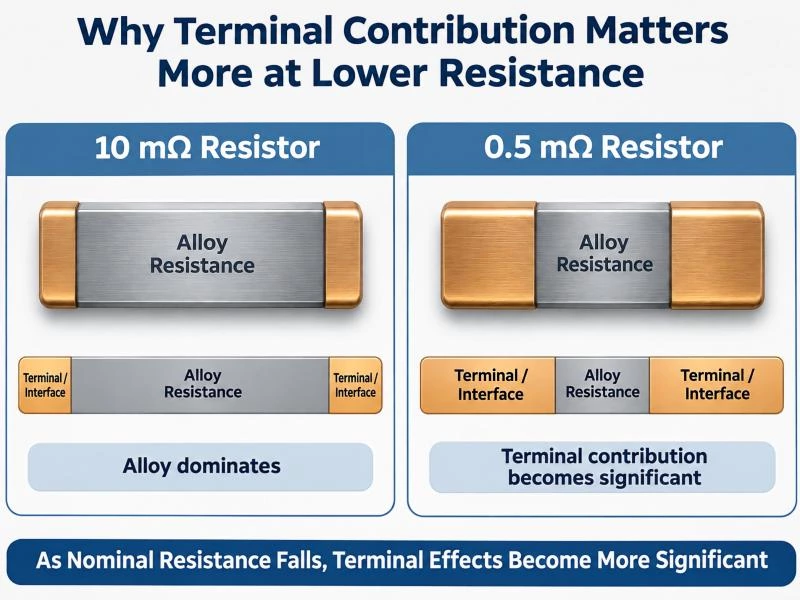
At higher resistance values, the precision alloy may dominate the total resistance. As the nominal shunt resistance becomes smaller, the relative contribution of copper and other conductive structures becomes increasingly important.
Practical implication: an alloy advertised with an extremely low material TCR does not guarantee that a finished 0.5 mΩ resistor will achieve the same TCR.
Why Lower Resistance Can Produce a Worse Component TCR
Suppose two current sense resistors use similar resistance-alloy technology and terminal construction, but one is 10 mΩ and the other is 0.5 mΩ.
In the 10 mΩ device, most of the measured resistance can come from the low-TCR element. In the 0.5 mΩ device, the absolute resistance contributed by terminals and interfaces may not shrink in the same proportion.
The terminal contribution therefore represents a larger percentage of total resistance, and its temperature behavior has greater influence on the finished component.
This is why comparing alloys only by their intrinsic TCR can lead to the wrong engineering conclusion.
Do Not Compare TCR Numbers Without Comparing the Test Conditions
A TCR number is meaningful only when the specification method is understood.
Three datasheets may all describe a resistor as “low TCR,” yet the numbers may have been determined over different temperature ranges or may refer to different parts of the resistor.
| Datasheet Question | Why It Matters |
|---|---|
| Is the number element TCR or component TCR? | Element-only data can exclude terminal and interface effects |
| What temperature range was used? | A narrow range can look better than performance across -55°C to +125°C or +170°C |
| Is the specification guaranteed or typical? | Typical performance should not automatically be used as a worst-case design limit |
| Does TCR change with resistance value? | Very-low-ohm variants may have greater terminal contribution |
| Is the TCR curve linear? | A single ppm/°C number can hide curvature across a wide temperature range |
This is particularly important when comparing sub-milliohm resistors. A component specified across a broad operating-temperature range should not be rejected simply because another device publishes a smaller TCR number over a much narrower range.
Copper-Manganese Alloys for Precision Current Sensing
Copper-manganese based alloys are widely used in precision resistance and current-sensing components because suitable grades can combine useful electrical resistivity with low TCR and stable resistance behavior.
Manganin is one of the best-known members of this group. It is typically based on copper, manganese and nickel and has a long history in precision shunts and electrical measurement standards.
Its value in current sensing is not simply that it is “a low-resistance metal.” The attraction is the ability of suitable grades and constructions to maintain a comparatively stable resistance while the component temperature changes.
Manganin Is Not One Universal Specification
The term Manganin should not be used as though every Manganin shunt has the same TCR or stability.
Actual behavior depends on alloy composition, processing, heat treatment, geometry, terminal design and operating temperature. Even within one resistor family, lower resistance values can show different TCR limits because the proportion of alloy resistance to terminal resistance changes.
The same caution applies to CuMn and MnCu designations. These labels identify a material family, not a complete electrical specification.
Copper-Nickel Alloys: Useful, but Thermal EMF Requires Care
Copper-nickel resistance alloys are also used in sensing and precision-resistance applications. Constantan is the most familiar name in this category, although “Constantan” itself refers to a family of Cu-Ni compositions rather than one universally identical alloy.
Cu-Ni alloys can provide useful resistivity and comparatively stable resistance behavior, which makes them suitable for certain resistor structures.
However, designers should be cautious with broad claims that Constantan automatically provides low thermal EMF against copper.
Constantan-type CuNi44 is also widely used as a thermocouple material precisely because a junction with copper develops a substantial thermoelectric voltage as temperature changes. In a current-sensing circuit, that behavior becomes important if the measurement path contains Cu-Ni/copper junctions at different temperatures.
Low TCR and low thermal EMF are different material properties. A material can perform well in one and not necessarily in the other.
Thermal EMF Matters When the Sense Voltage Is Small
Thermal electromotive force is produced when dissimilar conductive materials form junctions at different temperatures.
In ordinary power wiring, a few microvolts may be irrelevant. In a current-sense circuit, the useful signal may itself be only a few millivolts.
For example, a 0.5 mΩ resistor carrying 10 A produces:
V = 10 A × 0.5 mΩ = 5 mV
At lighter current, the signal falls further. A thermoelectric offset generated by an asymmetric temperature gradient can therefore become a measurable percentage of the signal.
The Material Pair Matters More Than the Material Name
Thermal EMF is a junction property. It must be evaluated between the resistance alloy and the conductor material connected to it, normally copper.
The practical questions are therefore not only:
“Does this alloy have low thermal EMF?”
but:
“What thermoelectric voltage can develop between this alloy, its terminals and copper under the temperature gradients expected in the actual resistor?”
This is particularly important for precision current measurement near heat sources, power semiconductors, busbars or uneven copper planes.
Long-Term Stability Is Different from TCR
TCR describes a largely reversible resistance change associated with temperature. Long-term stability describes permanent resistance drift after the resistor has experienced electrical, mechanical and thermal stress.
A resistor may return close to its original resistance after a temperature excursion and still accumulate a small permanent shift after repeated cycles.
Long-term drift can be influenced by material condition, manufacturing stress, joining quality, thermal cycling, overload events and mechanical strain transferred from the PCB or busbar.
| Behavior | TCR | Long-Term Drift |
|---|---|---|
| Main Driver | Temperature change | Accumulated operating and manufacturing stress |
| Usually Reversible? | Largely yes when temperature returns | Not necessarily |
| Relevant Time Scale | Immediate operating condition | Hours, cycles, months or service life |
| Effect on Current Measurement | Temperature-dependent gain error | Calibration drift over time |
For equipment that is calibrated once and expected to retain accuracy for years, long-term resistance stability can be as important as the initial tolerance.
What Prosemi Product Data Shows About Material and TCR
The relationship between alloy, resistance and finished-component performance can also be seen across Prosemi's current-sensing portfolio.
For example, different product series use CuMn, MnCu3, NiCu, Manganin and other resistance-alloy systems to achieve different resistance, power and TCR targets.
| Example Series / Material | Example Resistance Range or Value | Published TCR | Engineering Lesson |
|---|---|---|---|
| ALMN25 / CuMn | Selected ranges from 1 mΩ upward | As low as ±50 ppm/°C in listed ranges | CuMn can support low-TCR SMD current sensing when geometry and resistance range are appropriate |
| ALMP25 / NiCu | 1–100 mΩ in listed NiCu configurations | ±50 ppm/°C | Cu-Ni based material can also be engineered for stable current-sensing resistance |
| LMJ25 / MnCu3 | 0.5 mΩ | ±350 ppm/°C in the listed configuration | Extremely low resistance can increase the influence of construction and terminal contribution |
| SRC59 / Manganin | 0.2–0.75 mΩ in listed Manganin variants | Varies by resistance value | Even within one material family, TCR should be checked at the exact resistance and construction |
These values should not be interpreted as a laboratory comparison of the raw alloys because the resistor geometries and constructions are different.
Instead, they demonstrate the more important engineering point:
finished-component performance cannot be predicted from alloy chemistry alone.
For available resistance, TCR, package and power combinations, see Prosemi's metal alloy current sense resistors and the broader current sensing resistor range.
Material Choice and Construction Must Be Evaluated Together
The resistor element does not operate independently from the terminal structure.
A high-current design requires conductors large enough to carry current with manageable temperature rise. Those conductors are usually copper because copper offers low resistivity and effective heat spreading.
The design challenge is therefore a compromise:
| Design Need | Preferred Direction | Potential Conflict |
|---|---|---|
| Low terminal loss | More copper cross-section | More high-TCR copper can influence total resistance |
| Low component TCR | Greater proportion of low-TCR alloy resistance | May change geometry, power density or voltage drop |
| High power capability | Good thermal conduction into terminals | Thermal gradients can increase thermoelectric offsets |
| Very low resistance | Short, thick resistive path | Terminal and interface resistance become a larger percentage of total R |
This interaction is especially important in high-current metal alloy shunt resistors, where copper conductors and resistance-alloy sections may be joined to create a very-low-ohmic current path.
Why the Lowest Material TCR Is Not Always the Best Design
It is tempting to rank current-sensing alloys by one number and select whichever material has the lowest TCR. That approach can fail because the complete resistor must satisfy several electrical and thermal requirements simultaneously.
A lower-TCR material may require a geometry that produces an undesirable resistance, package size or power density. Another material may offer a better combination of resistivity, manufacturability, terminal compatibility and long-term stability for the target resistance.
The correct comparison is therefore not:
Which alloy has the smallest TCR?
It is:
Which material and resistor construction produce the required component TCR, resistance, thermal behavior and stability at the actual operating point?
A Better Way to Evaluate Current Sensing Copper Alloys
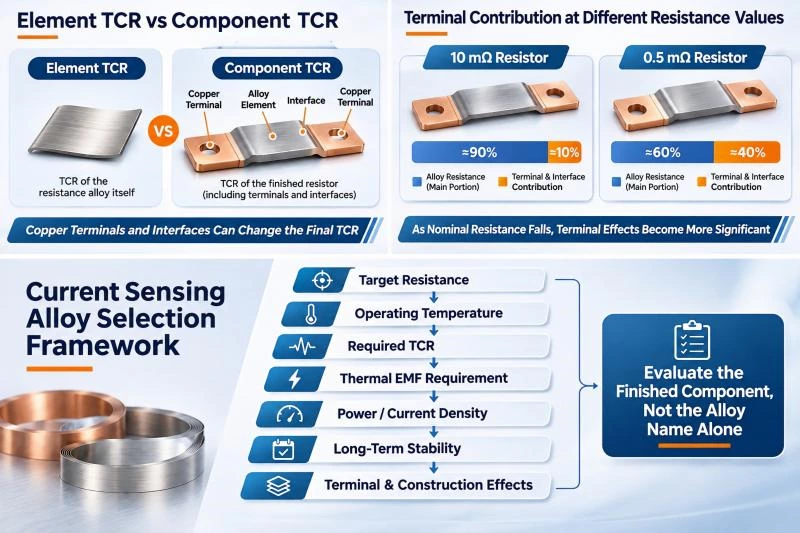
Instead of starting from an alloy name, start from the measurement error that the resistor is allowed to contribute.
| Evaluation Step | What to Check |
|---|---|
| 1. Define the temperature span | Use the actual resistor temperature range, including self-heating—not only ambient temperature |
| 2. Set the allowable resistance drift | Translate the current-measurement accuracy target into a maximum permissible TCR contribution |
| 3. Check the exact resistance value | Do not assume every resistance in one series has identical TCR behavior |
| 4. Review component-level data | Prefer complete resistor TCR over raw alloy TCR when both are available |
| 5. Evaluate thermal EMF | Especially important when sense voltage is small and junction temperatures are unequal |
| 6. Check stability data | Review load life, temperature cycling and overload resistance shift where long-term accuracy matters |
Common Material-Selection Mistakes
| Mistake | Why It Causes Problems |
|---|---|
| Choosing by alloy name alone | The same material family can produce different results in different resistor constructions |
| Comparing element TCR with component TCR | The numbers describe different levels of the design |
| Comparing TCR without checking temperature range | A narrow test range can make one specification appear artificially better |
| Assuming all Cu-Ni alloys have low thermal EMF against copper | Thermoelectric behavior depends strongly on the actual material pair and temperature gradient |
| Ignoring resistance-dependent construction effects | Terminal contribution becomes proportionally more important as nominal resistance falls |
| Using initial tolerance as a proxy for lifetime accuracy | Tolerance does not describe TCR or long-term drift |
What to Ask a Current Sense Resistor Supplier
For precision or high-current projects, a part number should be evaluated with more information than nominal resistance and wattage.
Useful technical questions include whether the published TCR is measured at component level, what temperature interval applies to the specification, whether TCR changes across the resistance range, what resistance shift occurs after load-life and temperature-cycling tests, and whether low thermal EMF performance refers to the complete terminal-alloy system.
For custom current-sensing requirements, Prosemi can match resistance, TCR, power, package and material options across different metal current-sense resistor structures. For project-specific requirements, contact the engineering team with the target resistance, continuous current, operating temperature and accuracy requirement.
Conclusion
Current sensing copper alloys should not be selected from a simple ranking of Manganin, CuMn, Constantan or NiCu.
The material sets the electrical foundation, but the finished resistor determines what the circuit actually measures.
Resistivity controls the geometry required to achieve the target resistance. TCR determines how resistance moves with temperature. Thermal EMF can add offset to small shunt voltages. Long-term stability determines whether the calibrated resistance remains trustworthy after repeated electrical and thermal stress.
Most importantly, copper terminals and interfaces become increasingly influential as resistance falls. This is why component TCR, exact resistance value, construction and temperature range are more useful than a raw alloy specification alone.
For accurate current measurement, the best material is not simply the alloy with the lowest published TCR. It is the alloy and resistor construction that maintain the required resistance behavior across the actual current, temperature and lifetime conditions of the application.
FAQ
Which copper alloy is best for a current sense resistor?
There is no universally best copper alloy. Manganin and CuMn-based materials are widely used where low TCR and stability are important, while Cu-Ni materials can provide useful resistivity and temperature characteristics in other resistor constructions. The final choice should be based on component-level TCR, resistance range, thermal EMF, power requirements and long-term stability.
Why is Manganin commonly used in precision shunt resistors?
Suitable Manganin grades can provide low TCR, stable resistance and favorable thermoelectric behavior against copper, making them useful for precision resistance and shunt applications. Actual performance still depends on processing, resistor geometry and terminal construction.
Is Constantan better than Manganin for current sensing?
Not automatically. Constantan-type Cu-Ni alloys can provide useful resistivity and relatively stable resistance behavior, but they can develop substantial thermoelectric voltage relative to copper. Manganin is often preferred where very low thermoelectric offset and precision stability are important, but the exact datasheet should determine the decision.
Why can two resistors made from similar alloys have different TCR?
The total TCR depends on more than the resistive alloy. Resistance value, element geometry, copper terminals, interfaces and measurement points all contribute. These effects become especially important at very low resistance values.
What is the difference between element TCR and component TCR?
Element TCR describes the temperature behavior of the resistive material itself. Component TCR describes the temperature behavior of the finished resistor, including terminal and construction effects. Component TCR is usually more relevant to actual circuit performance.
Are TCR and thermal EMF the same thing?
No. TCR describes how resistance changes with temperature. Thermal EMF is an additional voltage generated by dissimilar material junctions when a temperature difference exists. Both can influence current-measurement accuracy, but they are different physical effects.
Does the lowest TCR always give the most accurate current measurement?
No. Measurement accuracy also depends on resistance tolerance, thermal EMF, long-term drift, resistor self-heating, terminal contribution and the measurement electronics. A very low raw-material TCR does not guarantee the best finished resistor.