Ceramic Cartridge Fuses vs Glass Fuses: Key Differences Explained
When engineers talk about overcurrent protection, cartridge fuses are often one of the first components discussed. Among them, ceramic cartridge fuses and glass fuses are the two most common options. They may look almost identical from the outside, but their behavior during fault conditions is very different.
This article takes a practical, application-focused look at th
A Quick Look at Cartridge Fuses
Both ceramic and glass fuses belong to the same family: cartridge fuses. They share a cylindrical shape and operate on the same basic principle—when excessive current flows, the fuse element melts and interrupts the circuit.
The key difference is how the fuse handles the energy released during that interruption.
e real differences between ceramic cartridge fuses and glass fuses, helping you understand when each type makes sense—and when it doesn’t.
Ceramic Cartridge Fuses: Built for High Fault Energy
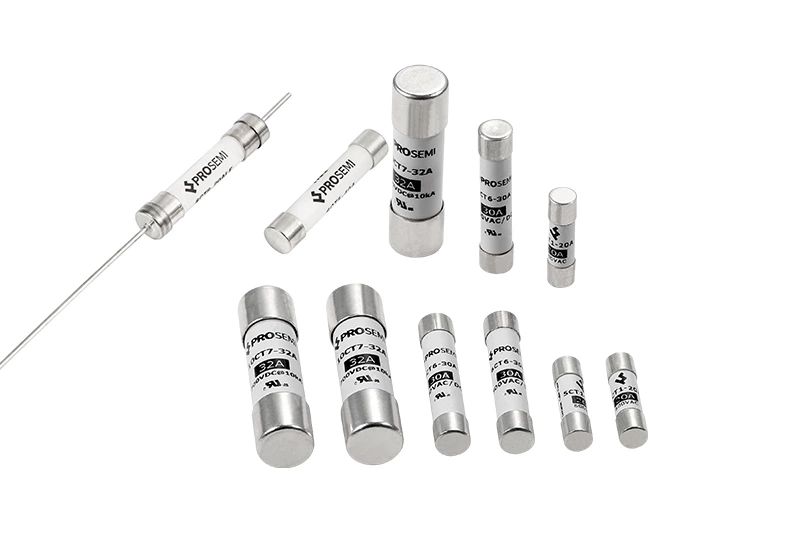
Ceramic cartridge fuses use a rigid ceramic tube instead of glass. This material choice is not cosmetic—it directly affects safety and performance.
In most ceramic cartridge fuses, the fuse body is filled with arc-quenching material. When a short circuit occurs and the element melts, the resulting arc is quickly cooled and extinguished. The ceramic body remains intact, even under extreme thermal and mechanical stress.
Because of this design, ceramic cartridge fuses are commonly specified in:
-
Industrial power supplies
-
Motor drives and automation equipment
-
EV charging systems
-
Energy storage and BMS applications
These are all environments where high fault currents are possible.
Glass Fuses: Simple and Effective for Low-Power Circuits
Glass fuses use a transparent glass tube, which makes them easy to inspect visually. If the element is broken, you know the fuse has blown—no meter required.
For low-power, low-fault-current circuits, this simplicity is often enough. Glass fuses are widely used in:
-
Consumer electronics
-
Small household appliances
-
Control circuits with limited available fault current
However, glass does not tolerate extreme heat or pressure well. Under high short-circuit conditions, the glass body may crack or shatter.
Breaking Capacity: The Key Difference That Really Matters
If there is one specification that separates ceramic cartridge fuses from glass fuses, it is breaking capacity (also called interrupt rating).
Ceramic Cartridge Fuses
- High breaking capacity
- Designed to safely interrupt large short-circuit currents
- Suitable for high-energy systems
Glass Fuses
- Limited breaking capacity
- Intended for circuits with low prospective fault current
In systems where fault current can reach several kiloamps, using a glass fuse is not just suboptimal—it can be dangerous.
Safety and Reliability in Real-World Conditions
Beyond breaking capacity, ceramic cartridge fuses offer better performance in harsh environments:
- Higher resistance to elevated temperatures
- Better tolerance to vibration and mechanical stress
- More stable behavior during thermal cycling
Glass fuses, while adequate for simple electronics, are far less forgiving in industrial or automotive conditions.
Application-Based Comparison
Instead of asking which fuse is “better,” it’s more useful to ask which fuse is appropriate.
| Application | Recommended Fuse |
|---|---|
| Consumer electronics | Glass fuse |
| Small appliances | Glass or ceramic |
| Industrial power supplies | Ceramic cartridge fuse |
| EV charging equipment | Ceramic cartridge fuse |
| Energy storage systems | Ceramic cartridge fuse |
As a rule of thumb:
- Low energy → glass fuses are fine
- High energy → ceramic cartridge fuses are the safer choice
Choosing Between Ceramic and Glass Fuses
Choose ceramic cartridge fuses if your system:
- Has high or uncertain short-circuit current
- Requires higher safety margins
- Operates in industrial, EV, or energy-related environments
Choose glass fuses if:
- Power levels are low
- Fault current is tightly limited
- Easy visual inspection is important
When in doubt, engineers often default to ceramic cartridge fuses for added safety—especially in modern power electronics.
FAQ: Ceramic Cartridge Fuses vs Glass Fuses (PAA-Oriented)
Are ceramic cartridge fuses better than glass fuses?
Not in every application. Ceramic cartridge fuses are better suited for high fault current and safety-critical applications, while glass fuses work well in low-power circuits with limited fault energy.
Why do ceramic cartridge fuses have higher breaking capacity?
They use a strong ceramic body and arc-quenching filler material, which allows them to safely contain and extinguish the arc formed during a short circuit.
Can a glass fuse be replaced with a ceramic cartridge fuse?
In many cases, yes—as long as the current rating, voltage rating, size, and time characteristic are the same. Ceramic fuses are often used as a safer replacement, but compatibility should always be verified.
Why are glass fuses still widely used?
Glass fuses are inexpensive, easy to inspect, and perfectly adequate for low-energy applications. There is no technical advantage to using ceramic fuses where fault current is minimal.
Where are ceramic cartridge fuses most commonly used?
They are widely used in industrial power supplies, motor drives, EV charging systems, energy storage equipment, and other applications requiring high breaking capacity.
Final Thoughts
Although ceramic cartridge fuses and glass fuses may appear similar, their performance under fault conditions is fundamentally different. Understanding these differences helps engineers and designers make safer, more reliable choices.
For applications involving higher power levels or greater fault energy, ceramic cartridge fuses are typically the preferred solution.