EV Fuses Explained: Types, Ratings, and Applications in Electric Vehicles
As electric vehicles (EVs) continue to evolve toward higher voltages, faster charging, and greater power density, electrical protection has become a critical safety requirement. Among all protection components, EV fuses play a fundamental role in preventing catastrophic failures caused by overcurrent and short circuits.
This article explains what EV fuses are, the main types, key ratings, and where they are used inside electric vehicles—from battery packs to charging systems.
What Are EV Fuses?
EV fuses are overcurrent protection devices specifically designed for high-voltage DC systems used in electric vehicles. Their primary function is to interrupt excessive current quickly and safely, isolating faulty circuits before damage, fire, or thermal runaway occurs.
Unlike traditional automotive fuses, EV fuses must handle:
- Much higher DC voltages (up to 1000 V DC)
- Extremely high short-circuit currents
- Fast fault response requirements
- Harsh thermal and vibration environments
Because of these demands, EV fuses are typically ceramic-bodied and sand-filled to improve arc suppression and breaking capacity.
Main Types of EV Fuses
EV fuses are classified based on voltage level, response speed, and application location.
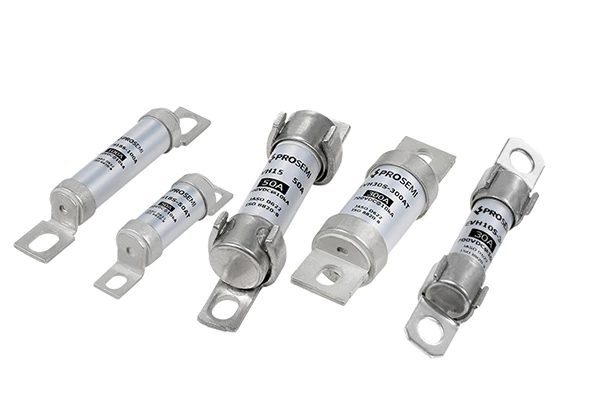
1. High-Voltage EV Fuses
Used in traction batteries and power electronics.
- Rated voltage: 400 V / 600 V / 800 V / 1000 V DC
- High breaking capacity (HBC)
- Designed for DC arc interruption
Typical applications:
Battery packs, inverters, DC-DC converters
2. Fast-Acting EV Fuses
Designed to interrupt faults almost instantly.
- Very short melting time
- Protect sensitive semiconductor devices
Typical applications:
Inverters, power modules, OBC input protection
3. Time-Delay (Slow-Blow) EV Fuses
Allow temporary surge currents without nuisance blowing.
- Withstand inrush current
- Stable under transient load conditions
Typical applications:
On-board chargers, auxiliary power circuits
4. Automotive-Grade Ceramic Cartridge Fuses
The most common structure used in EV systems.
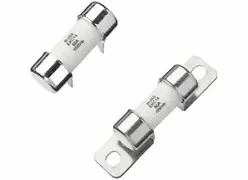
- Ceramic tube body
- Quartz sand arc suppression
- Reliable DC performance
This structure is widely adopted because it offers excellent thermal stability and mechanical strength.
Key EV Fuse Ratings Explained
Understanding fuse ratings is essential for proper selection. Below are the most critical parameters engineers consider.
Rated Voltage
The maximum system voltage the fuse can safely interrupt.
- Common EV levels: 400 V, 800 V
- Must always be equal to or higher than system voltage
Rated Current
The maximum continuous current the fuse can carry without blowing.
- Typically ranges from 10 A to 800 A+
- Often selected with 125–150% safety margin
Breaking Capacity (Interrupt Rating)
The maximum fault current the fuse can safely interrupt.
- Common values: 10 kA – 50 kA
- Especially critical in battery short-circuit scenarios
Time-Current Characteristic
Defines how quickly the fuse responds to overcurrent.
- Fast-acting
- Time-delay
- Partial-range or full-range protection (gR / aR)
Applications of EV Fuses in Electric Vehicles
EV fuses are distributed across multiple subsystems, each with different protection requirements.
EV Battery Pack & BMS
- Protects high-energy lithium-ion cells
- Prevents short-circuit and thermal runaway
- One of the most safety-critical fuse locations
Inverter and Motor Drive
- Handles high current and rapid switching
- Requires ultra-fast fault isolation
- Often paired with semiconductor protection strategies
On-Board Charger (OBC)
- Protects AC/DC conversion circuits
- Must tolerate inrush current during startup
- Requires high voltage and surge resistance
DC-DC Converter
- Steps high voltage down to 12 V or 48 V systems
- Needs stable protection under continuous operation
EV Charging Systems
- Used in fast charging and DC charging interfaces
- Must comply with international safety standards
- Critical for user and infrastructure safety
EV Fuse Standards and Compliance
Compliance with international standards is essential for EV applications:
- IEC 60269-4 (DC and semiconductor protection)
- UL 248-20 (North American requirements)
- ISO 8820 (Automotive fuses)
- AEC-Q200 (Reliability for automotive components)
Meeting these standards enhances system safety, regulatory approval, and market acceptance.
Why Ceramic Fuses Are Preferred in EV Applications
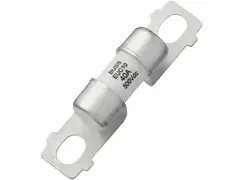
Ceramic EV fuses dominate the market for good reason:
- Higher breaking capacity
- Superior DC arc suppression
- Better heat resistance
- Long-term reliability under thermal cycling
Compared to glass fuses, ceramic fuses are safer, stronger, and more suitable for high-voltage EV systems.
Final Thoughts
EV fuses are not just protective accessories—they are core safety components that directly affect vehicle reliability and passenger safety. Selecting the right fuse type and rating ensures stable operation across the entire electric drivetrain.
As EV technology moves toward higher voltages and faster charging, the role of high-performance EV fuses will only become more critical.